A Wish List for a Genie: Dr. Doug Cardell on Socialism, Bubbles, and Bailouts
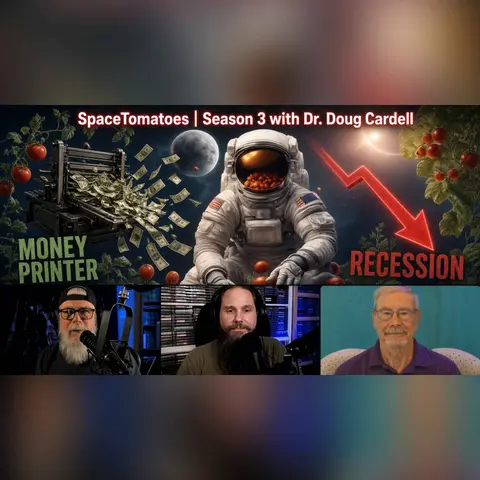
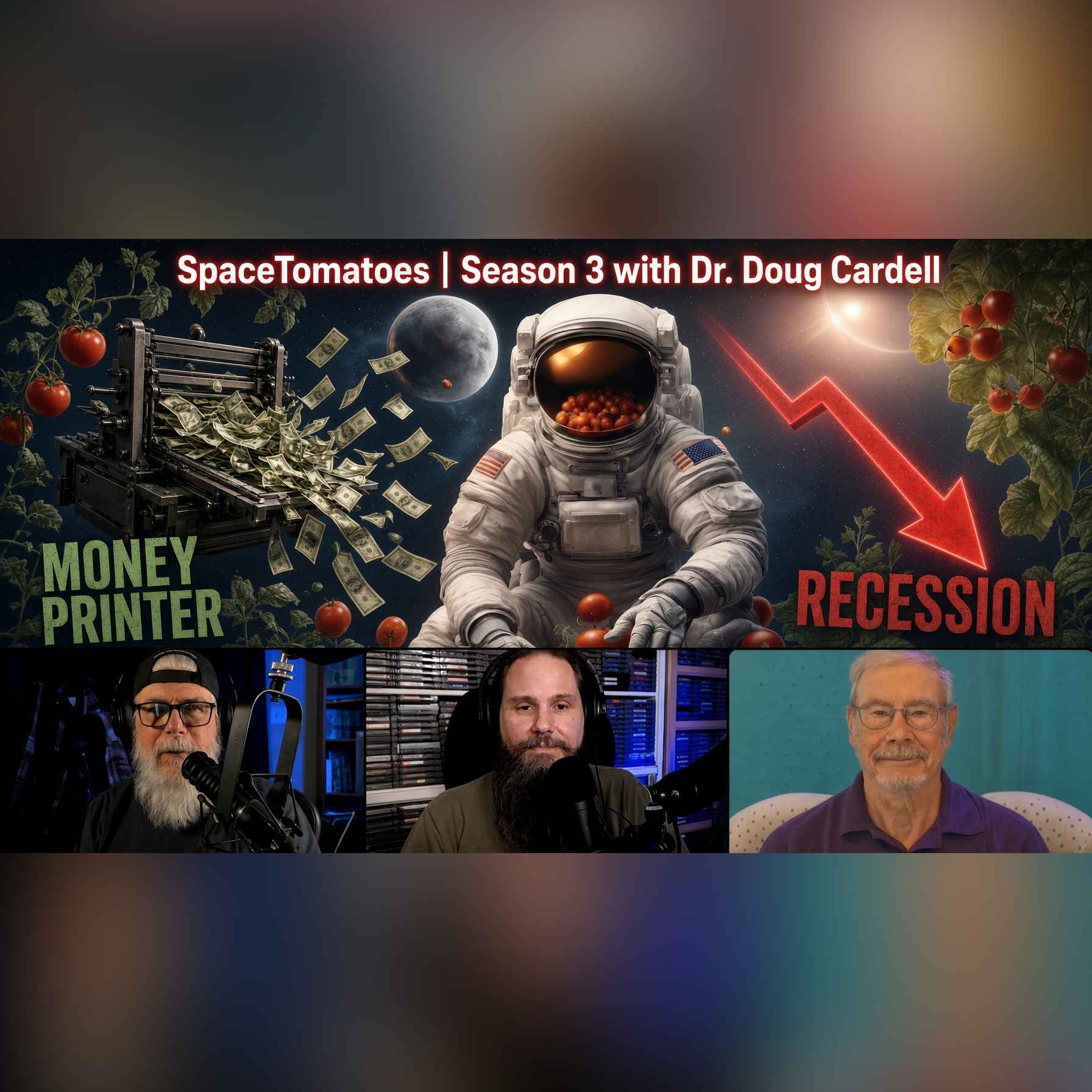
An economist read the entire Democratic Socialists of America platform and filed his verdict in one line: "It's not an economic policy. It's a wish list for a genie" [04:27]. Dr. Doug Cardell, author of Why Socialism Struggles and founder of evidentiary economics, returns to Space Tomatoes with Havok and LX on S3-EP18 to take that platform apart line by line, then explain why a $40 trillion nation is the worst possible lab for the experiment.
This is the full unscripted conversation: An Economist on Socialism, Bubbles, and Bailing Out (S3-EP18), or watch it on the official Space Tomatoes YouTube channel.
Key Takeaways
- The DSA platform is not a policy paper in Cardell's reading, it is a list of outcomes with no mechanism attached: free food, free housing, free education through a doctorate, a 32 hour workweek, open borders, no police, no military [02:24, 04:27]. LX asks the question the platform skips, how do you pay for it, at [05:10].
- The through line is spontaneous order. Cardell treats the economy, the environment, and the human body as three versions of the same self-organizing system, so government's role is guardian, not tinkerer [24:10, 26:39].
- Bailouts and mandates trade long-term resilience for short-term comfort. Suppress every small fire and the forest builds a megafire, buckle up and drivers learn to drive recklessly [32:41, 44:38].
- Money is the part people get wrong fastest. Printing past production turns a wheelbarrow of cash into a loaf of bread, and "Modern monetary theory, MMT, which basically says you can't cause inflation, print money all you want" is the idea he spends the Weimar, Zimbabwe, Venezuela, and Argentina chapter dismantling [01:00:06].
- The practical asks are boring and durable: the real minimum wage is zero [52:35], you get paid for created value rather than dug holes [47:17], and every high school should require economics [01:04:06].
The Wishlist, Read Out Loud
Cardell's method here is unusually unfashionable: he read the document. The Democratic Socialists of America publish their national platform, and what he recites from it at [02:24] and [04:27] is a list of desired outcomes, free food, free housing, free education through a doctorate, a 32 hour workweek, open borders, no police, no military, with no production story in between. His summary is the sentence this episode will be clipped for: "It's not an economic policy. It's a wish list for a genie" [04:27]. LX then asks the question the platform does not answer, how do you pay for it, at [05:10]. The counterweight the episode reaches for is historical rather than rhetorical: at [05:53] Cardell credits market coordination with collapsing extreme poverty over the last two centuries, a claim whose shape matches the long-run series in the World Poverty data at Our World in Data, which is where a skeptic and a believer should both go before arguing about it. He also concedes the honest hard case, does socialism work at small scale, and lands on the Amish answer at [06:35]: a community that voluntarily shares, with exit available, is not the same animal as a state that compels it.
Guardian, Not Tinkerer
The spine of the hour is one claim about how complex systems behave. At [24:10] Cardell argues the economy, the environment, and the human body are all spontaneously ordered, meaning nobody designed the outcome and nobody could have, and at [26:39] he draws the policy conclusion: government should act as guardian of the rules, not tinkerer inside the machine, a line he sharpens by noting the state buying equity in companies while preaching neutrality. Fire suppression at [32:41] is his best illustration, because it is the one case where good intentions are measurable. Forestry services put out every small fire for a century, dead fuel loaded the forest floor, and the result was the megafire that torches the canopy, which is exactly what he says happens when a market is never allowed to have a small correction, including the rent control case he walks step by step at [35:38]. At [34:16] he makes the distinction that keeps the argument from collapsing into anything-goes: cronyism is not capitalism, and sometimes the forest has to burn, which is the same reasoning behind his let it fail chapter at [14:34], where he argues too big to fail is a policy choice rather than a fact and reaches for the Dow 30 as his evidence. For the version of this argument applied to revolution and state legitimacy rather than markets, the neighbor episode is Eight Stages of Revolution with Rick Hoppe (S3-EP8).
The Printer, The Reserves, The Bubble
Money is where Cardell gets most impatient, because the errors repeat on schedule. He opens with the number that sets the table, $40 trillion in debt alongside the PPI miss and a stack of junk paper financing AI buildout at [11:32], then walks the mechanics: fractional reserve banking and what he calls the 3 percent problem at [43:25], QE as a permanent rather than emergency posture at [22:45], and the political impossibility of stopping a machine that makes every constituency's quarter look better. Modern monetary theory gets the longest look at [01:00:06], and his paraphrase of it is the clip we cut: "Modern monetary theory, MMT, which basically says you can't cause inflation, print money all you want," followed by the running gag that printing past production just means your wheelbarrow buys a single loaf of bread, with Weimar, Zimbabwe, Venezuela, and Argentina as the four receipts. The purchasing power figures he cites at [57:48], roughly 97 percent gone since 1913 and 81 percent since 1971, are his numbers and belong attributed to him, and the Minneapolis Fed inflation calculator plus the FRED CPI series are public if you want to check the math yourself rather than take anyone's word for it. The bubble anatomy chapter at [16:57] runs tulips, 1929, dot com, and 2008 through the same filter, fundamentals versus technicals, and the Federal Reserve's own history of the 1929 crash is a fair place to pressure test whether the pattern is as repeatable as he thinks. The 3 percent reserves and dot com parallel at [15:25] is where the AI conversation stops being a stock story and becomes a credit story.
What Capitalism Actually Does Well
The optimistic half of the episode is about adaptability, and Cardell's favorite example is a hull rather than a startup. At [13:14] he compares aircraft carriers to speedboats: during the war the same industrial base that had been building pleasure craft produced capital ships on a schedule no central plan would have dared promise, which is his proof that price signals organize production faster than any committee. That argument is the mirror image of the wishlist problem, and he drives it home with self-interest, which he carefully separates from selfishness at [08:02] and illustrates with cancer as the case study: a body whose cells all optimize for themselves is a body that dies, and a society whose members are compelled to stop pursuing their own ends has the same failure mode in reverse. He also states two contested claims on air that belong attributed rather than endorsed: at [28:49] he argues the human body is spontaneously ordered too and reaches for keto, carnivore, and fast twitch training as evidence, and at [31:33] he makes the "one size fits nobody" argument using the stocky runner, both of which are Cardell's hypotheses about his own training and diet rather than findings anyone should treat as medical advice. The same instinct, that a system works when the individual keeps skin in the game, runs through You Don't Own That Tractor with Geoff Wacker (S3-EP11), where ownership you cannot enforce turns out not to be ownership.
The Boring Fixes
For a guest with a title as combative as Why Socialism Struggles, the prescription list is almost aggressively moderate. At [45:22] he blames an education system that skipped class for the fact that supply and demand is treated as an opinion rather than a mechanism, and at [01:04:06] his ask is simply that every high school require economics. At [47:17] he draws the line between labor and value: digging holes pays nothing, you get paid when you create something somebody wants, which is the same thought he states as "People shouldn't work for a living, what we should be doing is creating value." The minimum wage chapter at [52:35] carries the other clip from this episode, "The real minimum wage is zero. Period," which is not a claim that nobody earns money but the claim that a price floor set above what a worker can be shown to produce prices the least productive worker out of the market, and he builds it through Milton Friedman's teaspoon builders rather than through a think tank chart. At [01:01:18] he widens the frame to financial literacy, unable to budget, unable to roll a car loan, and at [01:02:13] he hands listeners a permanent defense against headlines: watch whether a number is being reported as a percent or a level. None of this is a revolution, which is precisely his point, the wishlist is loud and the boring fixes are durable, and if you want the loud version of institutional reform on tape, the closest relative on this show is One Term Only with Evan Jaqua (S3-EP10).
The One Idea To Steal
- Read the document before arguing with it. Cardell's whole DSA segment is just someone who actually finished the platform, then quoted it.
- Ask who pays. Any policy that lists outcomes and skips production is a wishlist, not a plan [05:10].
- Guardian, not tinkerer. If a system is self-organizing, the useful role is enforcing rules, not steering results [26:39].
- Watch the suppressed correction. The fire you put out today is the fuel load you pay for later [32:41].
- Percent or level? Headlines hide the answer there [01:02:13].
Meet Dr. Doug Cardell
Economist, historian, and author of Why Socialism Struggles. Cardell is the founder of evidentiary economics, his term for a discipline that argues from data instead of from a policy preference, and at [59:12] he puts his own number on the problem, the 96/4 split he sees between agenda economics and evidence economics. He first joined Space Tomatoes on S2-EP15 to argue that socialism, communism, and fascism all end in the same place, government control of the economy, and he returns here for the sequel every guest eventually gets: what happens when the wishlist gets closer to power.
Where To Find Doug
- Site, books, and courses: dougcardell.com
- Why Socialism Struggles: on Amazon
- LinkedIn: Doug Cardell PhD
- The episode, chaptered 00:00 to 01:04:06: An Economist on Socialism, Bubbles, and Bailing Out (S3-EP18)
Related Episodes
- An Economist on Socialism, Bubbles, and Bailing Out (S3-EP18), the source conversation, chaptered end to end.
- Dead Stages with George Fontes (S3-EP13), the economy of real life from a man who sells what requires a crowd, groceries versus the stock market included.
- Eight Stages of Revolution with Rick Hoppe (S3-EP8), what a state does when it stops believing its own reporting.
- The Liberty Solution with Derek Wills (S3-EP4), the harder version of the same spontaneous order argument.
- One Term Only with Evan Jaqua (S3-EP10), institutional reform with a concrete list attached.
- You Don't Own That Tractor with Geoff Wacker (S3-EP11), what happens when the tinkerer owns the machine.
Watch full video episodes on the official Space Tomatoes YouTube channel: https://www.youtube.com/@SpaceTomatoes-Podcast
External Sources
- Democratic Socialists of America, national platform, the primary document Cardell reads on air.
- Federal Reserve Bank of Minneapolis, inflation calculator, and FRED, Consumer Price Index for All Urban Consumers, to check the purchasing power figures Cardell cites at [57:48].
- Our World in Data, World Poverty, the long-run extreme poverty series behind the [05:53] claim.
- Federal Reserve History, Stock Market Crash of 1929, for the bubble anatomy chapter at [16:57].
Final Note
The episode is at its best when Cardell stops arguing and just reads. Nobody needs to be convinced that free housing sounds nice. The interesting question is the one LX asks at [05:10], who pays, and the reason the answer never arrives in the platform is that the platform was written by someone who did not have to finish the sentence.
Play [04:27] first. If "it's a wish list for a genie" does not make you want to go read the actual document, nothing in the rest of the hour will.
22 Million Kids a Year: Keith Barton's 5-Page Fix for Family Courts