Russell Van Brocklen's AI Playbook: 3X the Output and Still Time to Swim (S2-EP19)
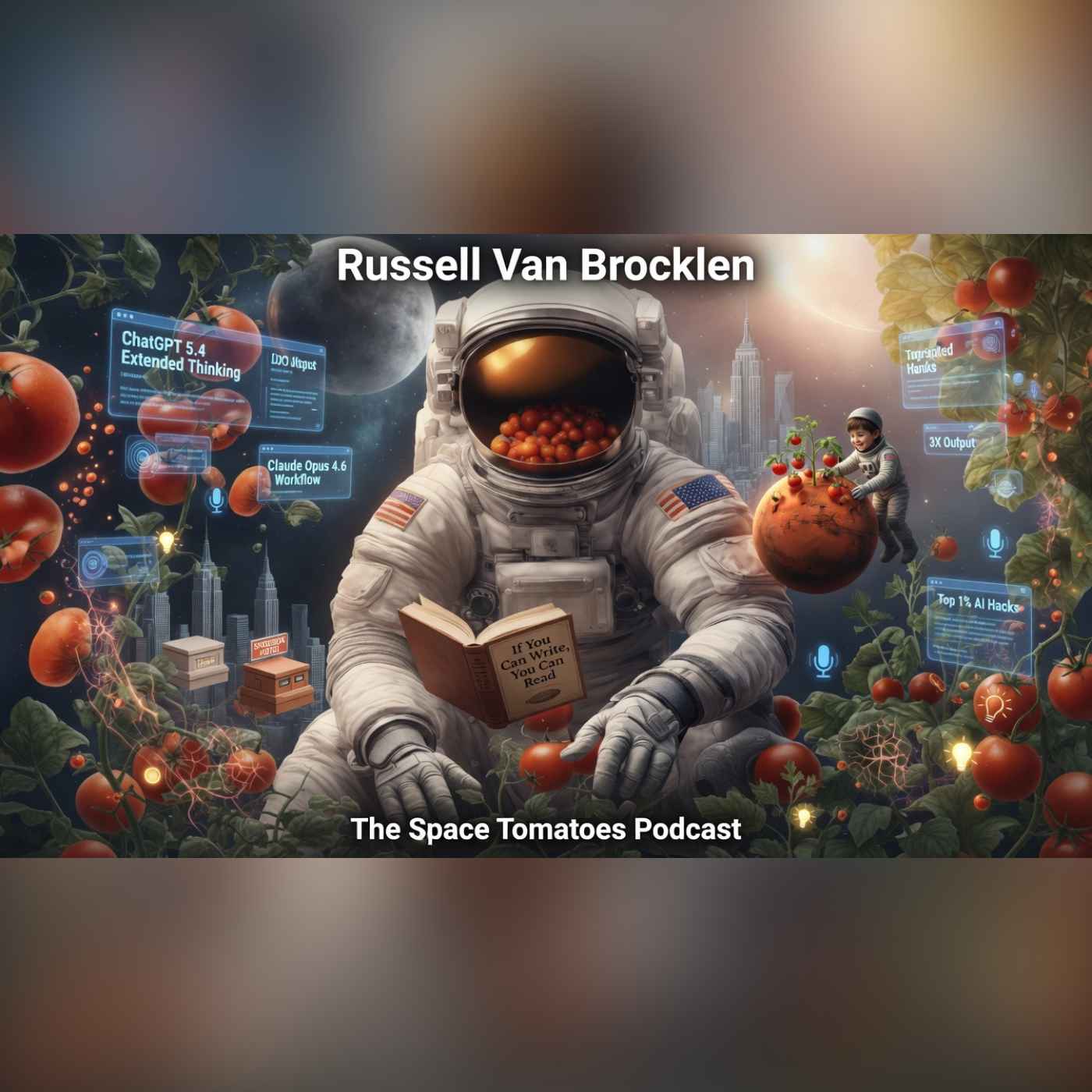
Short answer: Russell Van Brocklen treats AI like a paid teammate, not a search engine, and it buys him the thing regular workers cannot buy. Time. The dyslexia professor back from Albany shows Havok and LX the exact workflow he built for himself, one that runs two frontier models against each other until the work is 95 percent done, then ships under human eyes. He does two to three times a normal person's output and still leaves afternoons for the YMCA pool. "This is me. This is not some, I'm not freaking AI. And people know that I'm not freaking AI because of those things" [0:00]. Cat hair on the hat included.
This is the full unscripted conversation: Russell Van Brocklen Returns, Dyslexia Prof's 3X Productivity Hacks while Swimming (S2-EP19), or watch it on the official Space Tomatoes YouTube channel. His first visit, the dyslexia story that made him a repeat guest, is right here (S2-EP7), and his guest card lives at the guest page.
Key Takeaways
- Treat AI like a teammate, not a search engine, and pay for the tier that does real work. Russell runs the thinking in ChatGPT 5.4 extended thinking and the execution in Claude Opus 4.6 cowork, on separate jobs, checked against each other.
- Build memory and continuity. Stay on one model for at least a month so it can search what you actually do, then have it audit you. His intake was 196 questions across 16 areas, answered 10 at a time.
- Cross checking is what kills hallucinations. Work model drafts, thinking model critiques, human reads only the final draft. "Between the two, I'm finding the hallucinations are down to virtually nothing" [22:20].
- No AI for kids until they read and write at a real ninth or tenth grade level. Enter The Craft of Research: context, unique problem statement, unique solution. Kids trained on it are teaching their coworkers within two weeks.
- The dyslexia edge is real and employers notice. "When you're in your speciality and you know what you're doing, we have two and a half times that part of the neural activity in the brain, it becomes really unfair" [61:03]. Companies now pay for the subscriptions because the output pays for itself.
The Playbook In Plain Terms
The stack is two models doing different jobs. Russell says he uses ChatGPT 5.4 extended thinking for the thinking, meaning the plan, the critique, and the writing of the prompt itself, and Claude Opus 4.6 cowork for the execution, the agent runs that actually produce the documents. He is blunt about cost: the twenty dollar tier gets you a demo, the hundred to two hundred dollar tier gets you a teammate. The point is not to be online eight hours a day. It is to "do twice three times as much work as what a normal person would do and I'm using the rest of the time to you know have a life and to do podcasts" [7:02]. Swimming at the YMCA is non negotiable. His booking agent is told to protect noon to four so he can get an hour or ninety minutes in the pool, and the agent finds dates around that constraint like an assistant who never complains [14:42].
The memory move is the one people skip. You have to stay on Opus 4.6 for at least a month, because a model that has watched you work can search its own history and answer questions about your habits no other AI can answer [8:43]. He turned that into an audit loop: have the thinking model generate questions about what he is doing right and wrong, it produced 196 questions over 16 areas, then feed those to the work model in batches of ten, bring the answers back, and let the thinking model revise the next round of questions [12:01]. Halfway through, open a fresh conversation in the same project and have the model compile everything into a Word document. Two sets, each around 60,000 words, distilled into a personal service document of roughly 5,000 words that knows his mistakes and his strong points and "keeps me from making the same stupid crap over and over again" [18:50].
Then the double check. Work runs on one model, review runs on the other, and the loop does not end until the reviewer model signs off. Russell says the cross check is what tames the fake confident nonsense: "between the two, I'm finding the hallucinations are down to virtually nothing" [22:20]. He does not read anything until the reviewer says it is ready, reads once at about 95 percent, flags the one or two in ten runs that shipped something wrong, and then human eyes are the last gate, always. His shipping standard is aggressive and he knows exactly what it costs him: "ship it out there. And if one of my customers is going to complain because I didn't put a comma in the right place, well, fine. Go to my competitors. Have a nice day" [24:22].
The parenting rule is the one that surprises people. "I don't want the kids using AI until they can write probably around the 9th or 10th grade level for real. I don't want them touching it" [25:00]. His reasoning is the calculator story his physics professor told in the early nineties. Bring the textbook, bring the formula sheet, the exam does not get easier, because application is the skill, not the tool. Until a kid can actually read and write, AI just hides the gap. So the curriculum is The Craft of Research, the University of Chicago Press book he says "has sold over a million copies since 1995" [27:40]. Context, a unique problem statement, a solution you can actually deliver. Kids who learn it and then meet AI at eighteen do not catch up, they leap. Within two weeks on the job they are "training their peers in AI" [27:57], and one former student asked for a doubled salary, got told no, took the same offer from a competitor two weeks later, and expects to double it again [57:39].
The through line is that the productivity story and the dyslexia story are the same story. Russell's claim is neurological: dyslexic people, working in their specialty, run "two and a half times that part of the neural activity in the brain" and the extra output makes subscriptions a rounding error for employers [61:03]. He tells the story of a dyslexic young man who trained himself through Udemy courses bought on sale, started billing for the work, and now runs a two hundred dollar Claude seat plus twenty for ChatGPT while on track toward twenty to thirty thousand a month without college [60:30]. Another employee told a new boss he was hopeless at writing; the boss looked at the output and offered the expensive seat first. His book, If You Can Write, You Can Read, is his full argument that writing is the road back to reading for dyslexic learners, and the man who taught him to think in causality, Professor James Holmes at Buffalo, did not learn to read until fifth grade [67:53]. "If it wasn't for him, I would be nothing, nowhere" [68:29].
The Ten Moves, Short
- Treat it like a team member. "It's not a freaking search engine" [7:58].
- Build memory and continuity. A month minimum on one model so it knows your work.
- Batch tasks into 30 to 45 minute agent runs instead of ten tiny prompts.
- Prepare with it, do not just produce. He preps every podcast by feeding the booking discussion through the model first.
- Reuse prompts and systems inside project folders so nothing gets retyped.
- Make AI learn your mistakes, the 196 question audit above.
- Automate the boring stuff. Data entry, scheduling, reframing, so humans spend time on human work.
- Combine AI with your specialty. Feed your real expertise into a standing document, that is the secret sauce.
- Move faster than everybody around you. Top performers he cites run five to ten times normal output.
- Do not be afraid to look weird. He talks to the agent at social events and checks in five minutes out of every forty five.
Where Humans Still Own The Floor
This is not a replace-everyone sermon from the guy with the most advanced workflow on the show. Russell's position is that judgment, style, empathy, and the final call stay human, and the frontier is earlier than the hype. "We're not even at 1% of where we're going. We're at like 0.001" [35:49]. He cites the job data he trusts, about three openings chasing every qualified person who can actually run these tools, senior operators naming their price, and a hiring market where a spreadsheet expert with AI inside Excel did in forty minutes what a Goldman analyst said took a day [38:46]. He also gives the honest counterweight: companies exist to make dollars, so when replacing staff pencils out, they will do it, "99 by five nines of the companies out there will absolutely do that" [48:00]. His robot reality check is specific. The Boston Dynamics machine he describes is a man sized test unit, five foot nine, 70 pounds of payload, moving objects between tables at a factory [39:58], while the dexterity demos, nut to bolt, wing nut, one hand, came from a Chinese lab. Hardware lags the chatbots. His line on his own field's future is one he delivers grinning: the fastest way to a six figure income is being an electrician, and in ten years that electrician will probably be guiding robots [50:15, 50:32].
The Professor Who Changed The Trajectory
The show's standing question, the person who made an impact, got the answer that reframes the whole episode. Professor James Holmes did not learn to read until fifth grade, won the Indiana state science fair in the 1950s, went from C student to A student overnight, then to a PhD at Chicago's top economics program on the top scholarship, rewrote his dissertation a hundred times, and then always kept a co-author. Russell followed him from Plattsburgh to Buffalo specifically for that classroom. "He taught me how to think in causality. If it wasn't for him, I would be nothing, nowhere" [68:29]. Keep that in mind when the productivity guru tells you his system is for the gifted. It is for the kid who cannot read, the employee who says they are bad with writing, the fifty year old who never got the tool. The system is the equalizer. The book is the next version of it.
A Note From Russell
Russell asked us to pass this along to readers of the blog. His words, unedited:
"I was glad to join you on SpaceTomatoes. I have a small favor to ask.
Would you be willing to tell your audience about my free 90-minute call for parents of children who struggle with writing, including children with dyslexia? The call is with me, one family at a time.
Parents can book a time here: https://calendar.app.google/BvpukzuLYSTvw2qs5
Parents are also welcome at my free call every Tuesday at 8 PM Eastern.
A line in your newsletter, a social post, or a quick word on a future episode would all be a real help. There is nothing in it for you except my thanks, and no pressure at all if it is not a fit.
Thank you for having me on.
Russell Van Brocklen"
The free guide he mentions on the episode sits at DyslexiaClasses.com. As he says on the show, the site is spelled with an s, dyslexiaclasses.com, and his classes community is at the Dyslexia Classes Skool group. His full guest card, headshot, credentials, and booking links are on the Russell Van Brocklen guest page.
Where To Find Russell
- Website and free parent guide: DyslexiaClasses.com
- The Writing Method with live instructors: Dyslexia Classes on Skool
- Free 90 minute call for parents of kids who struggle with writing: book directly with Russell
- Free parent call every Tuesday at 8 PM Eastern, open to anyone
- Instagram: @dyslexiaclassesus
- LinkedIn: Russell Van Brocklen
Related Episodes
- Russell Van Brocklen Returns, Dyslexia Prof's 3X Productivity Hacks while Swimming (S2-EP19), the source conversation, unscripted end to end.
- Rewiring Brains and Conquering Chaos, Dyslexia Triumphs with Russell Van Brocklen (S2-EP7), where we first met the man with the 1000 page Walt Disney book.
- No Guests Just Chaos (S3-EP16), Havok and LX on their own local AI workflow, approval gates included, the hosts' side of the same rabbit hole.
- Russell Van Brocklen's guest card, links, book news, and where to find him.
External Sources
- The Craft of Research, University of Chicago Press, the Booth, Colomb, and Williams book at the center of Russell's teaching method, now in a fifth edition that covers generative AI directly.
- Boston Dynamics, Atlas, the electric humanoid robot platform Russell describes in his factory test remarks.
Watch full video episodes on the official Space Tomatoes YouTube channel: https://www.youtube.com/@SpaceTomatoes-Podcast
Final Note
Most AI content online is somebody reading a press release with better lighting. This one is a dyslexic professor with cat hair on his hat, two models arguing with each other in the background, a 10 year old headed for Mars, and a physics professor's eighty megabyte calculator grilling from 1992. Play the Grayson segment [5:08] for your skeptical friend, then the shipping-rant at [24:22] for your perfectionist one. Then book the free call for the kid in your life who fights with writing every night. The pool time is non negotiable, and so is the kid.
Collapse Aware Not Black Pilled: Christian Westbrook on Food, Water and Control (S3-EP19)