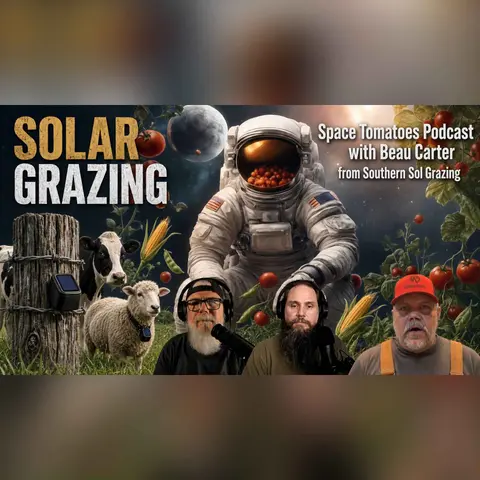
Paid to Farm Every Day: Beau Carter's Solar Grazing Empire (S3-EP20)
Never in the history of agriculture has a farmer been paid to farm. You get paid once a year when you sell the commodity, and nature gets a vote the whole time in between. Beau Carter of Southern Sol Grazing found the workaround: solar companies now pay him for the day to day act of farming itself. On Space Tomatoes S3-EP20, Havok and LX sit down with the middle Georgia regenerative grazer to walk through how vegetation management contracts under solar panels turn your commodity crop into nearly pure profit.
Key Takeaways
- Solar grazing pays farmers for daily husbandry work (grazing, rotating, watering) through vegetation management contracts, on top of the annual commodity sale.
- Utility and developer leases pay landowners roughly $750 to $1,000 per acre per year, and grazing keeps the land in agricultural use the whole time.
- The hay trap is real: cutting hay exports fertility off your farm. Winter stockpile grazing, borrowed from Greg Judy and Jim Gerrish's Kick the Hay, keeps nutrients walking on legs.
- Livestock behave like compounding ounces of gold: a cow tracks an ounce of gold and produces another one every year, while the gold ounce stays a single ounce forever.
- Land is the vault that caps herd growth. Solar acreage you never bought is an unlimited vault, and in Georgia and Florida alone Beau estimates 160,000 solar acres with less than 5% grazed.
- Geofence collars (tone first, then a pulse) let him move paddocks on sites hours away from his phone, turning a two hour fence-moving commute into a one minute app tap.
From a hay crisis to 11 solar sites in one year
The origin story is a drought. During the 2020 to 2021 season hay was nearly unobtainable, and Beau was running about 30 cow calf pairs close to the edge of selling cattle he did not want to sell. He made a vow to never be backed into that corner again, which sent him through Jim Gerrish's Kick the Hay and Greg Judy's No Risk Ranching, and eventually into stockpile grazing, creative leases, and a grazing gig that did not exist in his vocabulary yet.
The solar pivot came from a podcast, which feels appropriate. Driving back from an Alabama consultation in February, he heard a solar grazer on The Goat Grazing Podcast, pulled the car over on the shoulder, and joined the American Solar Grazing Association for about $75 on the spot. The ASGA map showed 25 solar sites within an hour and a half of his farm and zero grazers within three hours. By the end of that spring he had cold messaged his way (gate phone numbers, then LinkedIn, no profile, he made one) to 11 sites and roughly 350 acres, from Spartanburg, South Carolina to Bainbridge, Georgia to Jacksonville, Florida.
The flock math since then is the part that makes homesteaders sit up: from about 40 to 50 sheep and 10 cows at the start of the year to 380 sheep and 30 cows at writing, with a stated goal of 1,000 sheep and 100 cattle next year. Every dollar of contract revenue went back into animals and equipment.
Getting paid to farm: the economics, in Beau's numbers
The core reframe: never in history has a farmer been paid for the daily activity of farming. You are paid once a year for the commodity, and a late windstorm can still take the whole check. Solar changes the payer and the payee's daily life. A site that mows four to six times a year is buying a service, and the going rate for mowing commercial solar sites, per Beau's industry research, runs roughly $100 to $250 per acre per pass depending on region and forage load.
Run that forward: 300 acres at a hypothetical $400 per acre contract is $120,000 a year to do what a grazer was going to do anyway, move animals, rotate paddocks, handle water. The commodity crop at the end of the year becomes the byproduct, and since the contracts absorb most of the operating cost, that byproduct is nearly all profit. Beau signs NDAs on his own numbers, so that is the frame he gives the public, and it is enough to do your own napkin math.
The landowner side is the other shoe that drops. Utility and solar developer leases typically pay $750 to $1,000 per acre per year on 30 to 40 year terms with escalators, and reclamation clauses require the site returned to its prior state. The panels sit on driven I-beam posts, not concrete (the concrete-in-the-ground story is one of the hip pieces of misinformation Beau likes to retire; the only concrete on his 11 sites is the inverter pad). Land in production under the panels, taxed ag, grazed, and still payable for a generation.
Sheep, goats, cattle, and the edge effect
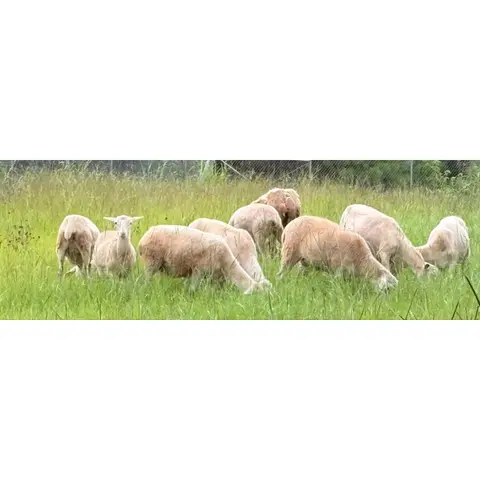
Beau thinks he is the only grazer running goats on solar in the country, and one of maybe three running cattle on solar, two of whom started after watching him post about it. Sheep are the industry default because they stay low and do not climb, but the stacks are what make a site sing.
Goats handle the South's real competition: blackberry, kudzu, and the thorny vine walls that swallow pasture edges. Goats will strip a bramble to tender shoots while cattle and sheep merely sample the leaves. Cattle scratch, but the racking posts are six inch I-beams driven four feet deep, bull proof by design. And the animals do not chew energized wire, because a cow that has been shocked once knows exactly which wires are alive, which is more than most of us can say for our own judgment.
The permaculture frame Beau brings is the edge effect: the forest edge where fungal and bacterial soils, sun and shade, converge is the most alive strip on the property. Under the panels the same convergence happens with light, and the grass under the arrays comes back darker green and longer. He quotes a line he likes from someone else: shade is solar's superpower for grazing. Animals with shade drink less, sweat less, and studies on cattle gain back that shaded steers put on more weight in summer heat.
Managing 11 sites from a phone: geofence collars and the robot
The logistics question Havok put to him: how do you run paddocks on sites four, five, six hours away? Physical polywire means an hour drive out, an hour drive back, every two to three days. Beau's answer is virtual fencing collars, tone first then a pulse, the same idea as a dog collar scaled up but with solar panels on the collar itself. His batch came in at every battery percentage from 15 to 100, and two months later the whole set sits in the mid nineties. Moving a flock is an app tap from the porch. He is picking up a herding robot the week after this episode aired, and the return visit is already booked.
Cows are ounces of gold that have babies
Beau's money section is the one people quote back to him. Historically an ounce of gold bought a cow and an ounce of silver bought a ewe, and the ratios still roughly hold. The difference is what happens next. An ounce of gold is a finished product; it will never be anything but itself. A cow is an ounce of gold that gives you another ounce of gold every year, and half of those ounces give you ounces of their own. A ewe at roughly five ounces of silver throws one and a half babies every eight to nine months, three breedings in two years, and the silver compounds.
The historical asterisk: your vault has a door, and that door is acres. Once titled land filled up, herd growth stopped unless you sold. Solar grazing pries the door open. He is expanding on 350 acres he never bought and never financed, on contracts that pay him while the herd compounds. No debt slave cycle, no four wheelers on payments, just Greg Judy's old trick (other people's land, other people's cows) scaled with photovoltaics.
LSU is testing his soil so the skeptics have to read it
The part that moves this from philosophy to documentation: a social scientist from Louisiana State University is running a three year study on Beau's solar sites. Haney soil tests for mineral profile, soil microscopy for the fungal to bacterial ratio (most grazed ground is bacterial dominant; wood chips and balanced grazing push it toward one to one), forage TDI testing for nutrient density, and toxicity screening to answer the panels-leach-heavy-metals claim with data instead of vibes. Beau deliberately let a neutral third party collect and run it, because his own lab receipts would never carry the same weight.
The practical farm takeaway already in motion: mineral buffets. Instead of one pre-mixed bag from the feed store, 21 minerals offered in separate compartments so each animal self-selects what its soil is short on, and the minerals walk back out onto the pasture in the manure, closing the loop the hay wagon used to steal from.
The dad question
Like every Space Tomatoes episode, it ends with the figure who shaped the guest. For Beau it is his dad, a Depression era baby born in 1938 who threw nothing away, grew what he could, canning and mending everything, because in his day you could not just drive to the hardware store. That voice is behind every low-input decision on the farm. His dad died in 1999, when Beau was in his 20s, and he says plainly that the years he got with him and the lessons he left are the foundation of the whole operation.
Where to find Beau Carter
X: https://x.com/sovernTranch (Homesteading4sovereignty)
Instagram and TikTok: search Southern Sol Grazing (he announced both new accounts on the episode)
LinkedIn: Beau Carter, Southern Sol Grazing
Email: southernsolgrazing@gmail.com (SOL like the sun)
Guest card on this site: Beau Carter's guest page
He also sat with Jack Spirko on The Survival Podcast, Epi 3925, Grazing Beneath Solar Panels, a good companion listen.
Hear the full episode
S3-EP20, "Paid to Farm Every Day - Beau Carter's Solar Grazing Empire." Watch it on the episode page, follow the show on the official Space Tomatoes YouTube channel, or catch it on Apple Podcasts or Spotify.
Want to be a guest on Space Tomatoes? Send us a message on PodMatch, here: https://www.joinpodmatch.com/spacetomatoes
Keep reading
If the money-under-the-pasture idea hooked you, Geoff Wacker's You Don't Own That Tractor episode post runs the same nerve: markets that work because people deal with people, not permits. For the hard money side of Beau's gold and cows analogy, Chris Liss lays it out in Why Your Dollars Are the Real Scam. And for preparedness framing around food control, Christian Westbrook's Collapse Aware, Not Black Pilled post picks up where Beau's sovereignty lens points.
Frequently Asked Questions
What is solar grazing?
Running livestock, usually sheep, on commercial solar sites under contract to manage vegetation. The grazer earns a vegetation management fee while the animals harvest forage, and the land keeps producing food alongside electricity. It is a form of agrivoltaics.
Who pays for solar grazing, and how much?
The solar asset owner, developer, or the operating company that runs the site pays the grazer, the same way they would pay a mowing contractor. Publicly discussed rates for mowing commercial sites run roughly $100 to $250 per acre per pass, four to six passes a year in the Southeast, per figures Beau cites on the episode. Actual contracts are often confidential.
Do solar sites ruin the farmland underneath them?
The common story says acres of concrete; what Beau has measured across 11 sites is driven steel posts and a small concrete inverter pad per site. Lease reclamation clauses require the site returned to its prior condition, and the ground grazes while the lease runs.
How much opportunity is there?
Beau estimates 160,000 acres of solar in Georgia and Florida alone with less than 5% currently grazed, and his own ASGA map showed 25 sites within 90 minutes of his farm when he joined. His advice: the directory plus a phone and thick skin gets the first contract.
Sources
Figures, handles, and story details above are Beau Carter's own statements from the Space Tomatoes S3-EP20 episode. Independent reads for context: the American Solar Grazing Association (the directory at the center of his origin story) and The Survival Podcast Epi 3925 with Bo Carter, where he walks the same model with Jack Spirko.
Russell Van Brocklen's AI Playbook: 3X the Output and Still Time to Swim (S2-EP19)